


[:it]Marchio tridimensionale KitKat: novità dalla Corte di Giustizia UE sulla distintività acquisita[:en]CJEU Kitkat ruling: new guidance on proving acquired distinctiveness of EU trademarks[:]
[:it]La forma della barretta di cioccolato “KitKat 4 fingers” potrà mantenere la registrazione come marchio tridimensionale dell’Unione Europea? Con una sentenza di interesse per quanto riguarda la dimostrazione della distintività acquisita da un marchio nell’Unione Europea, la Corte di Giustizia UE ha confermato la decisione del Tribunale UE: l’EUIPO dovrà pronunciarsi di nuovo sulla validità del marchio tridimensionale già concesso alla Nestlé.
L’Ufficio Europeo per la Proprietà Intellettuale (EUIPO) aveva concesso nel 2016 alla Nestlé la registrazione come marchio tridimensionale dell’Unione Europea della forma della barretta di cioccolato “KitKat 4 fingers” (all’epoca l’EUIP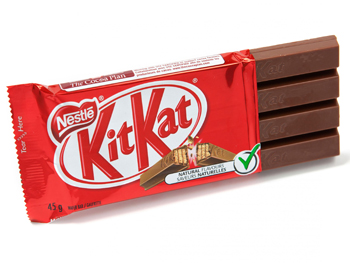 O era denominato UAMI e il marchio dell’Unione Europea era noto come marchio comunitario).
L’anno successivo la Cadbury Schweppes (ora denominata Mondelez) aveva richiesto che la registrazione fosse dichiarata nulla con la motivazione che la forma era priva di carattere distintivo.
L’EUIPO aveva rigettato la richiesta, opinando che il marchio avesse acquisito carattere distintivo tramite l’uso nell’UE, sebbene tale acquisizione fosse stata dimostrata in dieci paesi soltanto (Danimarca, Germania, Spagna, Francia, Italia, Paesi Bassi, Austria, Finlandia, Svezia e Regno Unito).
La Mondelez aveva presentato ricorso contro la decisione dell’EUIPO dinanzi al Tribunale dell’Unione Europea (Tribunale UE), il quale l’aveva annullata con sentenza del 15 dicembre 2016 nel procedimento T-112/13, ritenendo che l’EUIPO non potesse concludere l’indagine senza esaminare la percezione del carattere distintivo del marchio da parte del pubblico rilevante in tutti gli stati membri dell’UE (che all’epoca comprendeva Belgio, Irlanda, Grecia e Portogallo oltre agli stati elencati nel paragrafo precedente).
Il 25 luglio 2018 la Corte di Giustizia dell’Unione Europea (CGUE) ha emesso una sentenza nei procedimenti riuniti C-84/17 P, C-85/17 P e C-95/17 P riguardante i ricorsi presentati dalla Nestlé e dall’EUIPO contro la decisione del Tribunale UE.
La sentenza ha confermato che il Tribunale UE aveva agito correttamente annullando la decisione dell’EUIPO. La CGUE ha citato la propria giurisprudenza nel ritenere che un segno privo di carattere distintivo intrinseco può essere registrato nell’Unione Europea se è dimostrato che ha acquisito carattere distintivo tramite l’uso nella parte dell’UE – che può essere composta anche di un solo stato membro dell’UE – nella quale in precedenza il segno non possedeva tale carattere.
La CGUE ritiene quindi che ai fini della registrazione come marchio dell’Unione Europea di un segno precedentemente privo di carattere distintivo intrinseco, occorre dimostrare che il marchio abbia acquisito carattere distintivo in quegli stati membri UE nei quali il segno era originriamente privo di carattere distintivo intrinseco.
Secondo la CGUE, non è necessario che le prove presentate riguardino l’intero territorio dell’UE – a meno che il segno non fosse originariamente privo di carattere distintivo intrinseco nell’intero territorio dell’UE.
Nel caso del marchio KitKat 4 fingers, il segno era stato ritenuto privo di carattere distintivo in tutta l’UE, quindi non era sufficiente dimostrare che avesse acquisito carattere distintivo tramite l’uso in una parte soltanto – per quanto significativa – dell’UE.
La sentenza precisa altresì che le norme UE non richiedono che l’acquisizione di carattere distintivo tramite uso debba essere dimostrato con prove separate per ciascuno stato membro UE: possono essere considerate valide le prove dell’uso del segno all’interno di un mercato transfrontaliero che comprenda più di uno stato (ad esempio due stati in cui venga utilizzata la stessa lingua).
L’EUIPO dovrà riesaminare la richiesta di dichiarazione di nullità presentata nel 2007 dalla Mondelez relativa alla registrazione per il marchio tridimensionale KitKat 4 fingers concessa a suo tempo alla Nestlé.
Per informazioni
Sei interessato al deposito di un marchio tridimensionale? Contattaci per informazioni senza alcun impegno.[:en]Can the shape of the “KitKat 4 fingers” chocolate bar be granted registration as a 3-D trademark of the European Union? In a decision that provides new guidance on how to prove acquired distinctiveness of a sign in the European Union, the Court of Justice has confirmed the General Court’s decision, meaning that the EUIPO will have to issue a new decision on the validity of Nestlé’s 3-D EU trademark registration.
The EUIPO granted Nestlé a registration of the shape of the “KitKat 4 fingers” chocolate bar as a 3-D trademark of the European Union in 2006 (at the time, the EUIPO was called OHIM and the trademark of the European Union was known as the Community Trademark).
The following year Cadbury Schweppes (now Mondelez) applied for a declaration of invalidity of the registration, claiming that the shape lacked the required distinctive character.
The EUIPO rejected the application, taking the view that the mark had acquired distinctive character through use in the EU, although such acquisition had been proved in ten countries only (Denmark, Germany, Spain, France, Italy, the Netherlands, Austria, Finland, Sweden and the UK).
Mondelez appealed against the EUIPO’s decision before the General Court of the EU (General Court), whose judgement of 15 December 2016 in case T-112/13 annulled the appealed decision on the grounds that the EUIPO could not conclude its examination without ruling on the relevant public’s perception of the mark’s distinctive character in all member states of the EU (at the time, the states listed above plus Belgium, Ireland, Greece and Portugal).
On 25 July 2018, the Court of Justice of the European Union (CJEU) issued its ruling in joined cases C-84/17 P, C-85/17 P and C-95/17 P concerning the appeals brought by Nestlé and the EUIPO against the General Court’s judgement.
The decision confirms that the General Court was correct in annulling the EUIPO’s decision. The CJEU relies on its own case law to establish that a sign without inherent distinctive character can be registered as an EU trademark only if it is proved that it has acquired distinctive character in the part of the EU – which might consist even of a single EU member state – in which it did not previously have such a character.
The CJEU therefore concludes that for the purpose of registering as an EU trademark a sign that was formerly devoid of inherent distinctive character, evidence must be submitted that the trademark has acquired distinctive character in the EU member states in which the sign was originally devoid of inherent distinctive character.
The ruling points out that evidence must not be necessarily submitted for the entire European Union – unless the sign was originally devoid of inherent distinctive character in the entire European Union.
In the case at issue the KitKat 4 fingers sign had been found to be devoid of inherent distinctive character throughout the European Union, and therefore it was not sufficient to prove that it had acquired distinctive character through use only in a part – albeit a significant part – of the European Union.
The CJEU also points out in its decision that EU law does not require that the acquisition of distinctive character through use be established by separate evidence for each EU member state: evidence for use of a sign within a cross-border market comprising more than one state (for example, two states in which the same language is used) can be considered relevant.
The EUIPO will now have to re-examine the application filed in 2007 by Mondelez for a declaration of invalidity of the “KitKat 4 fingers” trademark registration granted to Nestlé.[:]