


[:it]Annullato marchio UE per Lanciatore di fiori di Banksy: deposito in malafede secondo l’EUIPO[:en]Banksy’s Flower Thrower EU trademark cancelled for bad faith filing[:]
[:it]L’iconico “Lanciatore di fiori” di Banksy non è più un marchio registrato dell’Unione Europea: la Divisione di Annullamento dell’EUIPO ha cancellato la registrazione per malafede, ritenendo che quando fu depositata la domanda di registrazione non sussistesse alcuna intenzione di utilizzare il marchio, e che l’uso iniziò, in ritardo, al solo scopo di evitare la perdita del marchio, come pubblicamente dichiarato dallo stesso artista.
 Banksy è lo pseudonimo di un artista di strada noto in tutto il mondo, ma che ha sempre mantenuto segreta la sua vera identità. Banksy ha dichiarato più volte che le sue opere, che di solito vengono dipinte con vernice spray in luoghi pubblici su supporti quali muri, vagoni della metropolitana e similari, sono liberamente utilizzabili da chiunque, a condizione che l’uso non sia a scopo di profitto. L’artista ha ripetutamente espresso disprezzo per l’idea di proteggere i diritti di proprietà intellettuale.
Negli ultimi anni la crescente popolarità di Banksy ha generato una notevole domanda di copie dei suoi lavori e in generale di merchandising tematizzato, che è stata soddisfatta da un certo numero di produttori e venditori di tali articoli, recanti copie non autorizzzte delle opere dell’artista.
Desideroso di mantenere il controllo sull’uso delle proprie opere, Banksy ha iniziato ad agire in tribunale per far rispettare il propri diritti d’autore, ma la sua scelta di continuare a mantenere segreta la sua vera identità lo ha ostacolato (era già accaduto anche in un tribunale italiano), il che non sorprende dal momento che i diritti di proprietà intellettuale, per poter essere azionati, devono essere attribuiti ad un proprietario chiaramente identificabile.
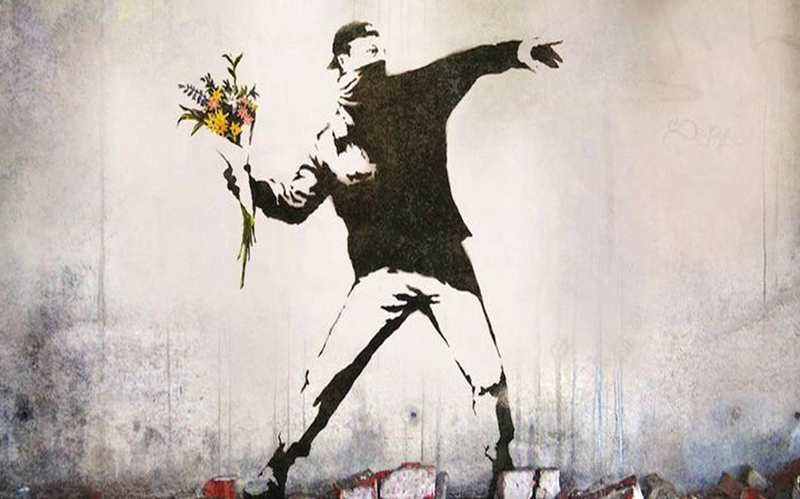
Banksy a quel punto aveva tentato di aggirare il problema tramite la registrazione come marchi dell’Unione Europea delle proprie opere di maggior successo, fra le quali il “Lanciatore di fiori”, registrato in data 29 agosto 2014 e qui riprodotto. I marchi furono registrati a nome della Pest Control Ltd., una società di servizi che agisce a nome dell’artista al fine di preservare il segreto sulla sua identità.
Full Colour Black Limited, impresa che commercializza cartoncini di auguri, aveva richiesto l’annullamento della registrazione del marchio, e la richiesta era stata notificata alla Pest Control Ltd., titolare del marchio, in data 20 giugno 2019.
Qualche mese dopo la richiesta di annullamento, la Pest Control Ltd. aveva aperto un negozio online, denominato Gross Domestic Product, per la vendita di merchandising ufficiale a tema Banksy.
Il 14 settembre 2020 la Divisione di Annullamento (DA) dell’Ufficio Europeo della Proprietà Intellettuale (EUIPO) ha annullato il marchio contestato con la motivazione della malafede.
In base alle prove fornite da entrambe le parti nella disputa, la DA ha stabilito che nel momento in cui la Pest Control Ltd. aveva richiesto la registrazione del marchio dell’Unione Europea, Banksy non aveva alcuna intenzione di utilizzarlo in relazione ai prodotti e servizi indicati nella richiesta stessa. Aveva iniziato ad utilizzare il marchio anni dopo, in seguito alla notifica della richiesta di annullamento, dichiarando più volte che tale uso era iniziato unicamente per evitare l’applicazione delle norme UE sul mancato uso del marchio nell’ambito della disputa riguardante il marchio stesso.
Ma tali comportamenti possono essere considerati malafede ai sensi della normativa dell’Unione Europea in materia di marchi?
La DA ha ritenuto che nel caso in esame fosse riscontrabile la malafede facendo riferimento alla giurisprudenza della Corte di Giustizia dell’Unione Europea, che si è espressa come segue nella sentenza nel caso Sky (C-371/18): una domanda di marchio senza alcuna intenzione di utilizzarlo per i prodotti e servizi (…) costituisce un atto di malafede (…) se il richiedente tale marchio aveva l’intenzione o di pregiudicare gli interessi di terzi in modo non conforme alla correttezza professionale o di ottenere, senza neppure mirare ad un terzo in particolare, un diritto esclusivo per scopi diversi da quelli rientranti nelle funzioni di un marchio.
La DA ha dunque concluso che quanto sopra si applica al caso in questione, dal momento che il marchio contestato “fu richiesto per permettere a Banksy di ottenere diritti legali sul segno dal momento che non poteva avvalersi del diritto d’autore, ma non è questa la funzione di un marchio. Dunque la richiesta di un marchio non può essere utilizzata a sostegno di tali diritti”. Pertanto la DA ha annullato il marchio per il “Lanciatore di fiori”.
La decisione della DA può essere oggetto di ricorso entro due mesi dalla data di notifica della stessa.
Contenuti correlati
Articles – Italy, Banksy Goes to Court (in Anonymity) by Angelica Torrigiani Malaspina (article first published in the INTA Bulletin).
[:en]The EUIPO’s Cancellation Division has declared invalid the EU trademark registration covering Banksy’s iconic “Flower Thrower” on the ground of bad faith, finding that at the time of filing there had been no intention to use the trademark and that use began long after the cancellation action was filed, but only to avoid losing the trademark on the ground of non-use, as publicly stated by the artist himself.
Banksy is the stage name of a street artist who is famous worldwide but has always kept his real identity secret. Banksy has stated several times that his works, usually spray-painted in public places on walls, in subway carriages and the like, are free for everyone to use upon condition that such use is not for profit. He has repeatedly expressed contempt for the idea of protecting intellectual property rights.
In recent years the popularity of Banksy’s works caused a susbtantial demand for reproductions of his art and for Banksy-themed merchandise in general, which was met by a number of producers and sellers of such products, unauthorised by the artist.
In order to maintain control of the use of his works, the artist began to take steps to enforce his copyrights in court, but his decision to continue to keep his real identity secret proved to be a hindrance (also in an Italian court, as we reported here), which is not surprising since intellectual property rights must be attributed to a clearly identified owner in order to be enforced.
Banksy thus attempted to circumvent this problem by registering as trademarks of the European Union (EUTMs) some of his most iconic works, including “The Flower Thrower”, granted registration on 29 August 2014 and pictured here. In order to maintain Banksy’s anonymity, the trademarks were registered in the name of Pest Control Ltd., a handling service acting on behalf of the artist.
An application to cancel “The Flower Thrower” trademark was filed by Full Colour Black Limited, a greeting cards seller and notified to Pest Control Ltd. on 20 June 2019.
Months after the cancellation action was filed, Pest Control Ltd. opened an online shop called Gross Domestic Product, selling official Banksy merchandise.
On 14 September 2020, the Cancellation Division (CD) of the European Union Intellectual Property Office (EUIPO) issued its decision upholding the cancellation action on the ground of bad faith.
Based on the evidence produced by both parties in the dispute, the CD found that at the time Pest Control Ltd. filed the application for registration of the EUTM, Banksy had had no intention to use the mark in relation to the contested goods and services. He only began using it years later, after the cancellation action was filed, and stated on several occasions that such use was only to overcome EU laws regarding the issue of non-use in relation to a trademark dispute.
But does such behaviour amount to “bad faith” under the European Union trademark law?
The CD found that it does according to the case law of the Court of Justice of the European Union, which held in its SKY ruling (C-371/18), that a trademark application made without any intention to use the trademark in relation to the goods and services (…) constitutes bad faith (…) if the application had the intention either of undermining, in a manner inconsistent with honest practices, the interest of third parties, or of obtaining, without even targeting a specific third party, an exclusive right for purposes other than those falling within the functions of a trademark.
The CD concluded that the above applied to the case at issue, as the contested trademark “was filed in order for Banksy to have legal rights over the sign as he could not rely on copyrights, but that is not a function of a trademark. Therefore, the filing of a trademark cannot be used to uphold these rights”, and declared “The Flower Thrower” trademark invalid.
The CD’s decision may be appealed within two months from the date of notification.
Related content
Articles – Italy, Banksy Goes to Court (in Anonymity) by Angelica Torrigiani Malaspina (article first published in the INTA Bulletin).[:]