

Donne e brevetti in Europa, a che punto siamo: nuova indagine dell’EPO
Una nuova indagine pubblicata dall’Ufficio europeo dei brevetti conferma che nei paesi europei un numero sproporzionatamente basso di donne sono citate come inventrici nei brevetti europei; questo divario di genere è troppo basso rispetto alle percentuali di donne attive nel mondo delle imprese e della scienza, ed è più ampio in Europa che in paesi quali Stati Uniti, Cina e Corea del Sud.
Quanto è inclusiva l’attività inventiva in Europa? Alle scienziate europee sono riconosciute pari opportunità rispetto ai colleghi?
Uno studio pubblicato a novembre 2022 dall’Ufficio europeo dei brevetti (EPO) fornisce dati, approfondimenti e conclusioni, aggiornati e accurati, sulle differenze di genere nella tutela dei brevetti negli stati membri dell’Organizzazione europea dei brevetti, con l’obiettivo dichiarato di agevolare i responsabili politici, nonché il pubblico in generale, nel rispondere a queste domande e affrontare i problemi sottostanti.
Women’s participation in inventive activity – Evidence from EPO data, pubblicato nel novembre 2022, è il primo studio condotto dall’EPO volto a rilevare la presenza delle donne tra gli inventori nelle domande di brevetto europeo in 38 stati membri; lo studio si basa quasi interamente sulle domande di brevetto europeo depositate tra il 1978 e il 2019.
Progressi nella riduzione del divario di genere
Lo studio dimostra che mentre negli ultimi decenni sono stati compiuti progressi effettivi, con il tasso di donne inventrici nelle domande di brevetto europeo cresciuto dal 2% alla fine degli anni ’70 al 13,2% nel 2019, la quota di donne che compaiono nelle domande di deposito di brevetti si rivela sproporzionatamente bassa; inoltre, il divario di genere è più ampio in Europa che in altri paesi quali Stati Uniti (15% di donne inventrici), Cina (26,8%) e Corea del Sud (28,3%).
Tassi di donne inventrici negli stati membri dell’EPO
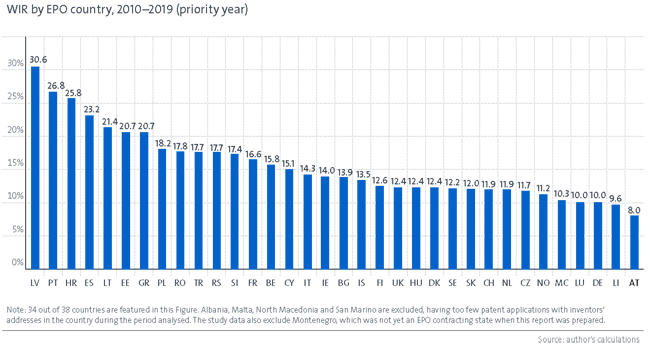
Il grafico rappresenta per 34 paesi EPO il Women inventor rate, ovvero la percentuale di donne citate come inventrici nei brevetti dal 2010 al 2019. Fonte: Women’s participation in inventive activity – Evidence from EPO data.
Gli stati membri dell’Organizzazione europea dei brevetti con il più alto tasso di donne citate come inventrici nelle domande di brevetto europeo negli anni dal 2010 al 2019 (vedi figura) sono Lettonia, Portogallo e Croazia, mentre Germania, Liechtenstein e Austria hanno i tassi più bassi. L’Italia si classifica 16a fra i 34 stati membri per i quali i dati sono disponibili.
Le differenze tra gli stati sono in gran parte dovute alle specializzazioni tecnologiche e al contributo delle università e degli enti pubblici di ricerca all’attività brevettuale.
Ad esempio la chimica, e in particolare le biotecnologie e la farmaceutica, sono di gran lunga i settori tecnologici con più donne inventrici, e le donne compaiono molto più di frequente nelle domande di brevetto provenienti da università ed enti pubblici di ricerca rispetto che in quelle provenienti da imprese o singoli inventori.
Le donne nelle imprese, nelle attività scientifiche e nei brevetti
Lo studio mette a confronto il tasso di partecipazione delle donne all’attività brevettuale con gli indicatori della loro presenza in altre attività economiche e scientifiche nei primi nove paesi EPO per numero di brevetti europei: Belgio, Danimarca, Francia, Germania, Italia, Paesi Bassi, Spagna, Svezia e Regno Unito.
L’evidenza è che per tutti e nove gli stati la quota di donne lavoratrici è generalmente compresa tra il 40% e il 50%, ma la loro quota tra gli inventori di brevetti europei è in media solo tra il 10% e il 20%, nonostante tutti i paesi tranne uno abbiano un tasso del 30% o superiore di donne tra i dottorandi in discipline STEM, così come tra il personale di R&S e di ricerca.
Lo studio conclude che, sebbene il contributo delle donne alla brevettazione sia cresciuto nel tempo, è ben lungi non solo dall’equilibrio tra i sessi, ma anche dalla proporzionalità rispetto al numero di donne attive nelle attività economiche e scientifiche in genere, e in particolare alla percentuale di donne dottorande e ricercatrici.
 Scarica PDF
